
Behavior analytics
User and resource behavior
Spot unusual activity. Understand what changed.
Recognize unusual activity by understanding how identities, hosts, accounts, and resources normally behave. Qyronis shows behavioral changes with their baseline, supporting events, confidence, and relationship context. Analysts can open an anomaly, compare it with expected business activity, and use related alerts or cloud findings to decide whether further investigation is warranted.
Observed sequence
Assessment
A deviation is useful only when its evidence is clear
An anomaly means the activity differs from an established pattern. It is a reason to investigate, not proof of an attack. Qyronis shows what changed and whether there is enough recent data to support the assessment.
Behavior change path
- Baseline
- Change
- Context
Meet the engine behind the analysis
Qyronis learns a baseline before it calls out a deviation.
Behavior begins in a visible learning state. When enough observations exist, Qyronis can compare new activity with the established pattern and show the score, confidence, reasons and evidence state together.
Explore Qyronis behavioral intelligence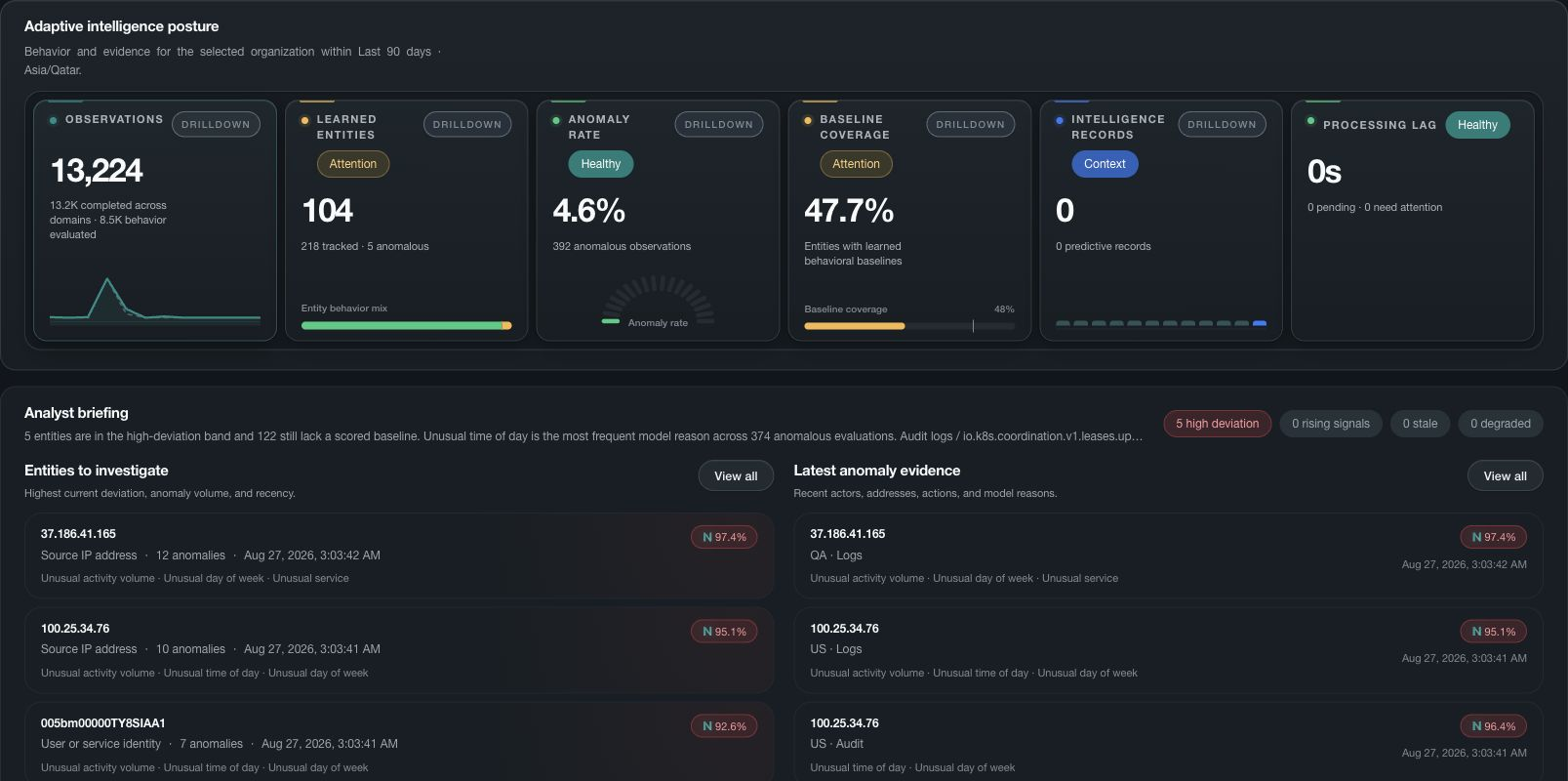
From anomaly evidence to analyst review
Keep behavioral context attached to the source activity and the case.
Use the anomaly assessment alongside the original events and related alerts. It does not replace the investigation or automatically trigger a response.
Explore security operationsObserved sequence
Assessment
Strengthen security operations
Give analysts the context to act with confidence.
Behavior learned for your organization
Learn behavior separately for the identities, hosts, accounts and resources in each customer environment.
Baseline before anomaly
Keep learning visible until enough evidence exists to compare new activity with an established pattern.
Reasons, score and confidence together
Show why behavior differs from the baseline instead of presenting an unexplained anomaly label.
Coverage and freshness stay visible
Keep missing, stale and partial evidence distinct from routine behavior and a trustworthy result.
Sequence hypotheses, not intent verdicts
Review sequences of activity for signs that need investigation. A behavior model cannot prove an attacker's intent.
Cloud and threat context remains independent
Review behavior assessments beside cloud findings and threat intelligence. These provide additional investigation context without changing the original anomaly result.
FAQ
Questions about Behavior Analytics powered by Qyronis.
What is Qyronis?
Qyronis detects unusual behavior in users, resources, and services by comparing activity with patterns learned for your organization. It explains what changed, how confident the assessment is, and whether enough recent data is available. Unusual activity still needs investigation before it is treated as a threat.
Does a Qyronis anomaly mean the activity is malicious?
No. Qyronis highlights activity that differs from an established pattern. Analysts need to review the original events, related activity, and available data before deciding whether it indicates a threat.
How does Nova handle missing, stale or partial evidence?
Nova keeps complete, partial, degraded, unavailable, not applicable, not assessed and unknown states distinct. Missing evidence never becomes a passing control, normal behavior, low risk or proof that no threat exists.
Evaluate Nova
See how Nova fits your cloud security workflow.
In a private briefing, we will map Nova to your stack, confirm what connects and focus the evaluation on the outcome your team cares about.