
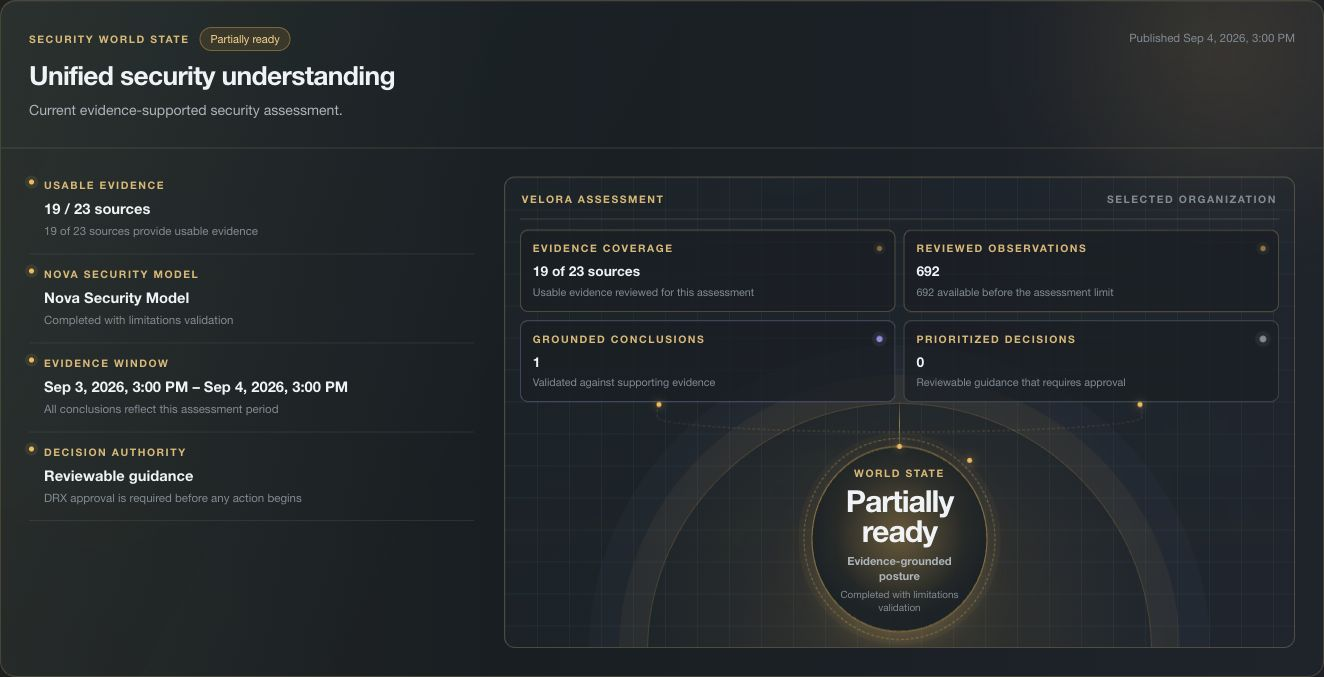
What assistance means in Nova
Nova can help connect evidence, summarize a case, rank supported signals, explain contributing factors, draft a detection proposal, frame a hunt question, or recommend a next step. The assistance is tied to a defined product task rather than an open-ended claim of autonomous judgment.
Different engines provide different kinds of assistance. Qyronis assesses behavior change. NovaSignal explains priority. The Nova Autonomous Detection Engine drafts coverage improvements. Velora connects and reasons over a case. Their outputs keep their own meaning and limits.
Evidence comes before generated language
- Source records remain available for review instead of being replaced by a summary.
- Observed facts, supported conclusions, assumptions, and unresolved gaps remain distinguishable.
- Confidence, coverage, freshness, citations, and missing evidence remain part of the decision context.
- If a required source is unavailable, Nova should show the limitation rather than inventing a complete answer.
Decisions your team controls
- Investigation judgment
- The analyst decides whether the evidence supports escalation, closure, or further investigation.
- Detection activation
- A drafted detection does not become active until it passes the configured validation and review path.
- Response approval
- A recommendation or proposal does not grant permission to perform a provider action.
- Risk acceptance
- Nova can present evidence and tradeoffs, but the responsible customer role owns the acceptance decision.
Prime assistance is eligible and controlled
Nova Prime can add citation-validated natural-language synthesis for eligible cases when the environment is entitled, the required service is ready, and the customer policy permits its use. Prime is an enhancement to Velora assistance, not an eighth ACDP engine and not a separate source of truth.
A case can remain useful without Prime. The evidence-led assessment, entities, timeline, confidence, and gaps remain the durable foundation.
Controls to test during an evaluation
- Can reviewers open the source evidence behind an assisted conclusion?
- Are uncertainty, missing coverage, and stale information visible?
- Can the customer define where assistance is enabled and which cases are eligible?
- Do proposals remain separate from approval and execution?
- Can the team review the final decision and the evidence used to reach it?